
Brasilidade Empresarial · Interview
Eder Theodoro, Global IT Director of Thyssenkrupp Forged Tech: what remains human when everything can be automated
Published on 10 September 2026. Interview by Fabiana Di Pietro. Originally published in Portuguese, with the author's own English version.
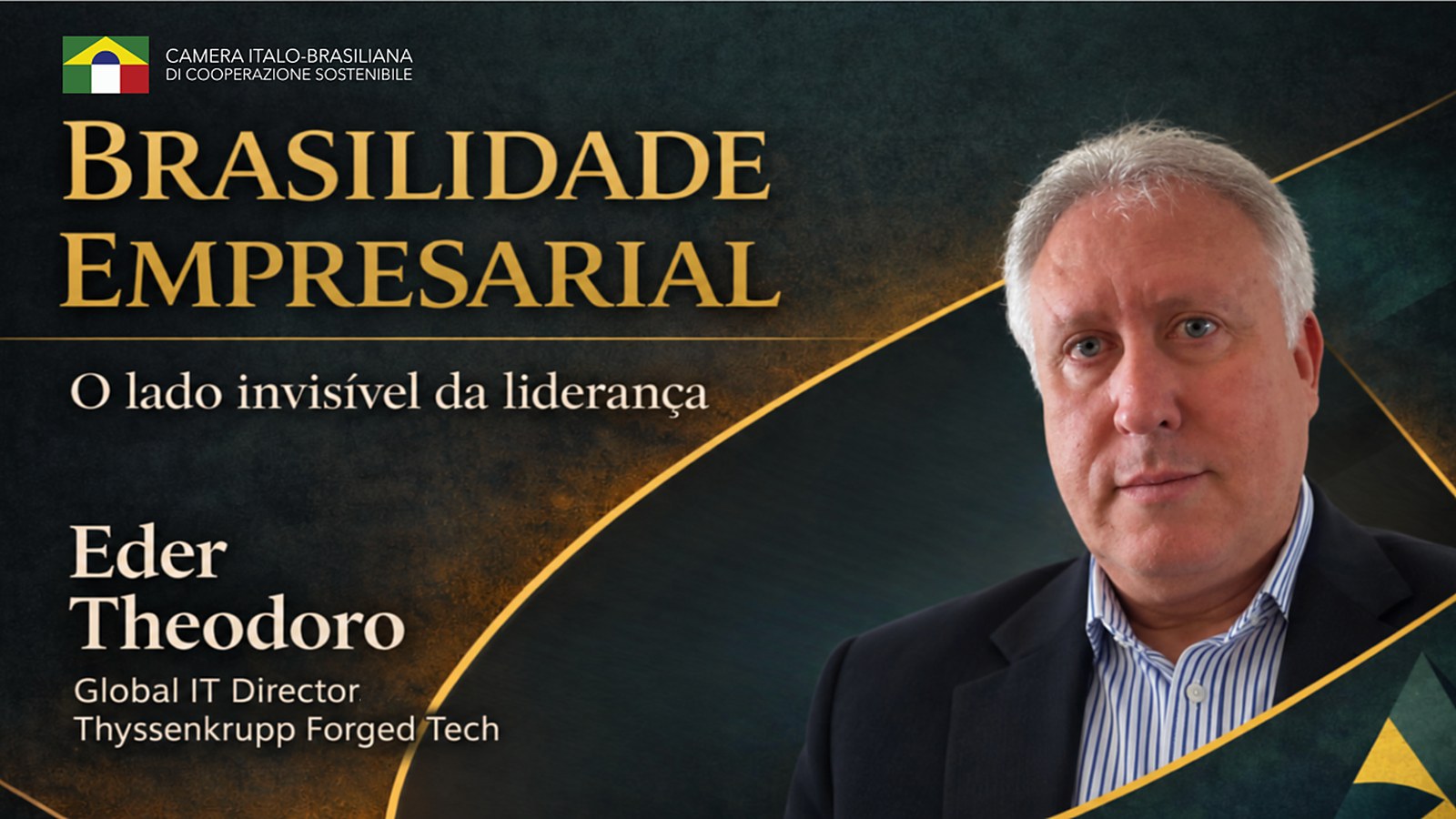
Eder Theodoro built his career in technology through a somewhat unexpected path. Before taking on global leadership positions in the industrial sector, he found himself torn between two very different possibilities: pursuing a career in sports journalism, which had long been his passion, or stepping into a field that, at the time, represented the future and endless opportunities for discovery.
Curiosity and the desire to explore this new world ultimately prevailed.
Throughout his career, he has worked for organizations such as Siemens, Nokia, and Thyssenkrupp, operating across Brazil, Europe, and Latin America in environments marked by transformation, integration, and operational complexity.
Today, as Global IT Director of Thyssenkrupp Forged Tech, part of thyssenkrupp Automotive, he leads technology on a global scale, where efficiency, cultural diversity, and critical decision-making intersect every day.
In this conversation, we discuss what technology has taught him about logic, what international experience has revealed about leadership, and why, even in increasingly automated environments, certain decisions remain deeply human.
Before technology became your profession, what did it represent to you?
At that time, technology represented the future.
When I was choosing a university degree, I was divided between two fields. One was sports journalism, which I already knew, enjoyed, and could clearly envision as a career path. The other was technology, which was still relatively unfamiliar to me. Journalism was a choice driven by passion. Technology was a choice driven by discovery.
I understood what journalism meant to me. What attracted me to technology was precisely the fact that I did not yet know what it could become. That uncertainty played a significant role in my decision. I ultimately enrolled in a Systems Analysis program without having extensive exposure to the field. In fact, I initially had limited experience with logical reasoning and programming concepts. However, university opened an entirely new path.
What began as curiosity became something truly transformative.
You mentioned logic. How did that choice change the way you think?
It primarily changed the way I organize my thinking and my work.
When you work in technology, you quickly learn that logic is not a detail. It is foundational. You begin to think in terms of sequences, dependencies, priorities, and consequences. Everything needs to make sense. Everything needs to connect.
More than any specific experience, it was the discipline of technology itself that shaped the way I approach work and decision-making.
Looking at your role today, what do you feel you really do?
The role of technology has evolved significantly over time. At one stage, the primary objective was simply to keep systems running. Later, technology also became a means to connect functions and enable collaboration. Today, for me, the core mission is transformation.
Organizations are experiencing a far greater pace of change than ever before. The range of possibilities has expanded, and so has the speed at which change occurs. As a result, leading technology today is not just about operating infrastructure. It is about helping the organization transform in a thoughtful and responsible way.
Artificial Intelligence is an excellent example. It represents a disruption that is advancing even faster than many previous technological shifts.
In global organizations, there is always tension between standardization and local realities. How do you navigate that?
That tension exists all the time.
On one hand, centralizing certain decisions creates scale, efficiency, and consistency. On the other hand, those closest to local operations often understand needs that a central organization may not fully see.
Ultimately, the most important criterion is the actual impact on the business. The best decision is not necessarily the one coming from headquarters, nor the one coming from the local organization. It is the one that creates the greatest value in a specific context.
For that approach to work, decision-making criteria must be clear, understood, and respected. Without clarity, any decision risks appearing arbitrary.
When you look at technology risk, why do people remain the most sensitive factor?
Because technology can be acquired. Processes can be designed. People cannot.
In most cases, the technology is available. Processes can be documented, organized, and controlled. People, however, are constantly evolving. They have different levels of knowledge, different profiles, and different rates of adaptation.
Without effective communication, knowledge transfer, and adequate preparation, performance inevitably suffers. At the end of the day, companies are still built around people.
How can that risk be mitigated in practice?
Through training, communication, and clear accountability. It also requires identifying individuals who can bridge the gap between technology and the business. Those internal connections make a tremendous difference.
Not everyone learns at the same pace, and that is perfectly natural. The role of leadership is to create an environment where different profiles can perform successfully.
Today, Artificial Intelligence has significant potential to support this process by accelerating access to information and providing operational assistance.
During major transformations, such as global system implementations, what usually happens before the benefits emerge?
Any meaningful change creates an adjustment period. It is common to hear people say that the old system was better. That happens because every transition affects habits, workflows, and expectations.
For that reason, the most critical period is often immediately after implementation. This is when real operational challenges begin to surface, and the organization must respond quickly. We refer to this as hypercare: a period of intensive support until the new solution achieves stability.
This process is part of every serious transformation effort.
In an increasingly automated environment, what would you never delegate to a system?
Decision-making.
Systems can support decisions, suggest alternatives, accelerate analysis, and enhance capabilities. But accountability for decisions remains a human responsibility. Technology can provide clarity. It cannot assume responsibility.
For me, maintaining that distinction is essential.
Leading teams across different countries, what has international experience taught you?
That talent has no nationality.
When you work with multicultural teams, you quickly realize that talent is distributed everywhere. Within our organization, we have colleagues from China, India, Italy, Brazil, and Germany. We strive to leverage the knowledge and expertise of each individual, regardless of nationality, to achieve the best outcomes for the company.
I see this diversity as a tremendous asset. I constantly seek to learn from people from different countries and to incorporate the best aspects of each culture. What differs are perspectives, communication styles, cultural references, and ways of working. Learning to navigate these differences broadens your perspective and strengthens your ability to find solutions.
Looking at Brazil from a global perspective, what strength do Brazilians bring with them?
Adaptability.
Brazilians tend to adapt quickly to new, ambiguous, and complex environments. We have a strong ability to operate effectively in imperfect conditions, under pressure, and amid constant change.
In global markets, that capability creates real value. It becomes especially important during periods of transition, when not everything is clear and the answers have yet to emerge.
Many Brazilians underestimate this strength, but it is very real.
After everything you have experienced, what remains at the center of your leadership approach?
Decision-making.
If I need to make a decision on my own, I make it. If I need to seek input from others, the decision to seek that input has already been made. If I need to delegate, the decision to delegate has also been made.
For me, leadership is not about controlling everything. It is about understanding what each situation requires and acting with clarity and purpose.
Technology changes. Structures change. Tools change. But judgment, accountability, and the ability to make decisions remain fundamentally human.
Are you a Brazilian leader working in Italy or in Europe?
The Brasilidade Empresarial Executive Community brings together Brazilian executives to share experience, widen connections and turn individual journeys into collective intelligence.