
Brasilidade Empresarial · Interview
Carlos Eduardo de Lima, the Brazilian leader behind GSK's global transformation in quality
Published on 18 June 2025. Interview by Fabiana Di Pietro. Originally published in Portuguese; this is a translation.
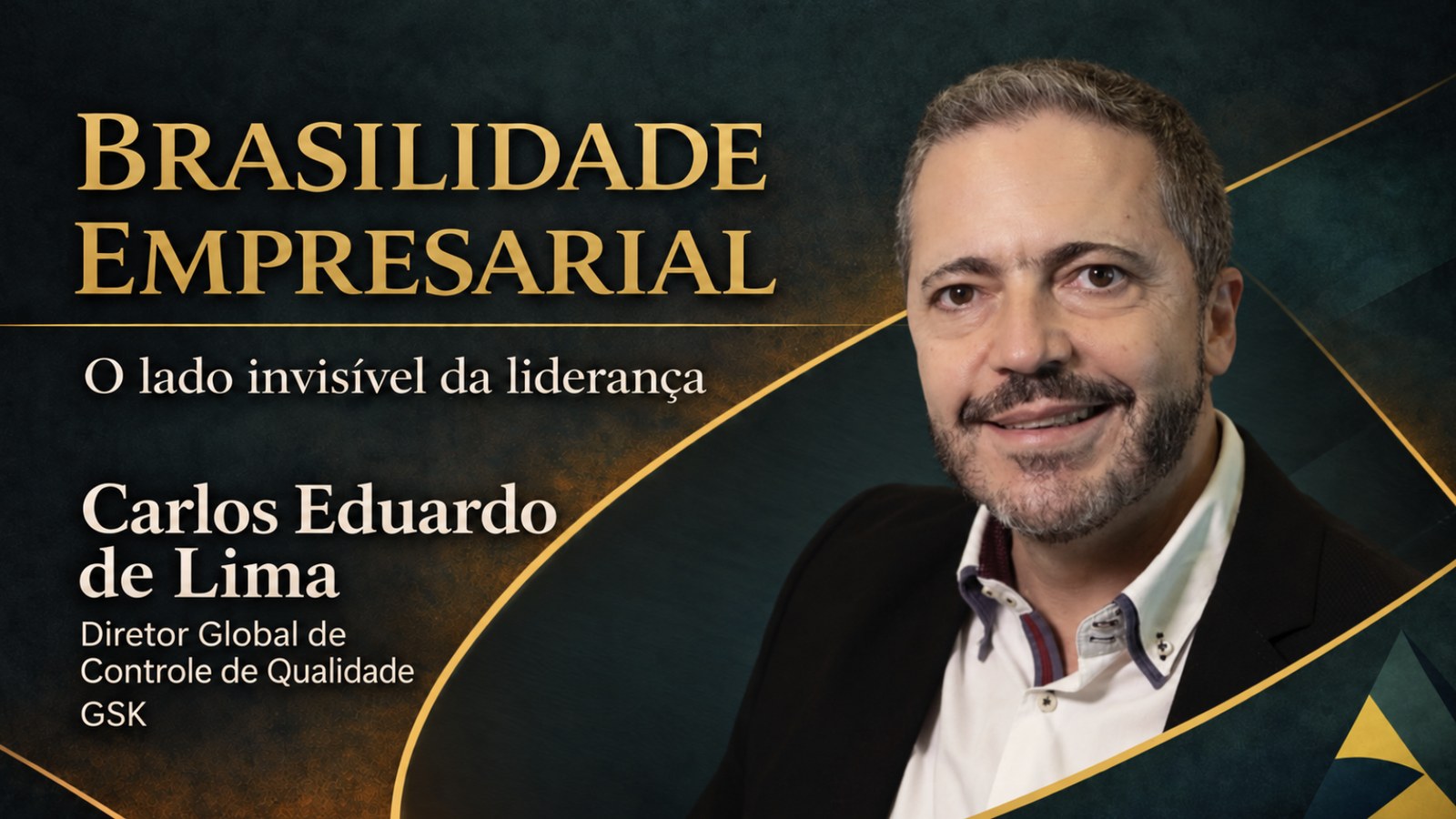
Leading global Quality Control processes, he connects strategy, operations and technology with a focus on simplicity, delivery and impact.
As GSK's Global Director of Quality Control, Carlos Lima leads the transformation of the area's planning and scheduling processes worldwide. He brings together quality, supply chain and digital innovation to ensure agility, efficiency and compliance in the production of medicines and vaccines.
Having worked at Novartis and Nestlé, Carlos has built his career across Brazil, Italy and the wider world, acting as the link between operations and strategy. In the age of artificial intelligence, what sets him apart remains human: clarity in communication, focus on delivery and the critical judgement to turn complexity into practical, effective decisions.
In this interview he talks about the future of the pharmaceutical industry, the value of brasilidade in global settings and his choice of a life with more balance and more purpose.
What was the turning point that put you at the centre of GSK's global transformation?
It all began with something local, when I was running GSK's Quality Control operation at the Siena site. My team and I implemented, on our own initiative, a quality standardisation system. It was the company's first delivery completed 100%. That led me to build the business case for a single global solution. When the project was approved, they asked me to lead it, and then to take on global responsibility.
The project also gained momentum from my experience in different companies and sectors, which brought both range and credibility. Although I am not a systems engineer, I know the operation and I translate real needs into workable solutions. That helps build systems that are useful and true to reality, and avoids theoretical solutions disconnected from practice.
What was the move from an operational role to a strategic one like?
It was a significant change. When you are in operations, everything is urgent. It is a great deal of responsibility and it consumes a great deal of energy. During Covid I never stopped. I worked every day from the first day of the pandemic. In a global role you step out of today's urgency and start working with tomorrow in mind. It is more strategic, more about setting standards and planning ahead.
When you were starting out, did you see yourself as someone who would transform the global quality standards of a pharmaceutical giant?
Honestly, no. Two years before university entrance exams I wanted to be a lawyer: my father is a lawyer and I enjoyed arguing a case. But I also had a feel for chemistry. One day I took part in a chemistry olympiad and came first. That stayed with me. Then I saw that chemistry made sense. It was simple, intuitive. So at some point it became clear that this was a possible path. At the time my father even asked whether I was sure, because he would not have been able to pay for another course. So I knew I had to decide and stick with it. I had to make it work. I have never regretted it.
And how did you end up in the pharmaceutical industry?
Almost by accident. I was looking for work and a vacancy came up in Quality Control at Cyba-Geigy, which about six months later became Novartis. I took it and, without noticing, I was completely immersed in the world of pharmaceutical quality, and that is where I found myself. Years later my mother showed me a school notebook in which I had written that I wanted to work at Cyba-Geigy. I had no memory of it at all.
Your career began at the company you had written in your school notebook that you wanted to work for. What came next?
I spent almost 12 years at Novartis, then nearly 6 at Nestlé, and later returned to Novartis, by then focused on vaccines. Each of those experiences was distinct: different cultures, different sectors, different ways of operating. But all of them kept me connected to quality and to the laboratory. And it was that varied range that prepared me for the global role I have today.
And how did the chance to leave Brazil and build an international career come about?
It was not planned, but the interesting thing is that I nearly went to the United States earlier, when I was at Nestlé, for a global project. In the end it did not happen. Later the chance came to join a vaccine plant project in the north-east of Brazil. With the transition from Novartis to GSK, the project was closed. GSK decided to redeploy the people involved, and then came the invitation to come to Italy. It was not a dream of mine, but things simply unfolded.
On the international side, how do you lead a project of that scale, across so many countries and contexts?
With clarity and simplicity. I like to plan in great detail, but without rigidity. It is a mix of traditional structure and agility. What matters is that the team knows where it is heading. There is no point delivering something good once it is no longer needed. Timing is everything.
I also believe knowing the operation helps enormously: a global system that does not reflect day-to-day reality simply does not work. I am not a systems engineer, I cannot write code, but I know exactly what the system has to do in order to work in practice. That makes a difference.
And how does your team respond to that style of leadership?
They know they can count on clear direction. I like to communicate in an accessible way, so that nobody is left in doubt. That brings confidence and gives the team speed.
Do you see artificial intelligence in this context as an ally or a threat?
As an ally, with challenges attached. AI can speed up product development and take over standardised technical tasks. But the human difference will be critical judgement: interpreting variables and deciding with awareness. AI does not do that yet.
You mentioned earlier that strategic work takes away the urgency of operations. What is your routine like today? What do you do outside work?
These days I value my own time a great deal. I like gardening, riding my motorbike, enjoying the sunset in Tuscany. I try to make the most of time with my family. Those were choices I made over the past few years and I am very happy with them.
What advice would you give young Brazilians who dream of an international career?
Make choices and face the decisions. Every choice means giving something up. But it is possible to build something good with what we have. Believe that. I was not sure it would work out, but I went at it determined to make it work. Brazilians adapt, and that is a strength. Knowing how to handle the new, keeping your good humour even through difficulties and connecting with different cultures are very much ours. And they make all the difference in global settings.
I often say: do not have dreams, make plans. A dream is abstract, out of reach. A plan is something concrete, something you can do. And more than planning: deliver. That is how I have always tried to live. That is how I got here.
Are you a Brazilian leader working in Italy or in Europe?
The Brasilidade Empresarial Executive Community brings together Brazilian executives to share experience, widen connections and turn individual journeys into collective intelligence.